

Coursera and Udemy are now one company, creating the world’s most comprehensive skills platform
Today, I’m excited to share that we have completed the Coursera-Udemy combination, bringing together two mission-driven companies to create one of the world’s most comprehensive skills development platforms. This marks an important step forward in our ability to better serve our learners, customers, partners, and instructors around the world. Together, we now reach over 290 million learners, 18,000 enterprise customers, and a global ecosystem of 95,000 content creators, alongside hundreds of university and industry partners. We’re joining forces at a pivotal moment. AI is transforming every job across every industry. To adapt and thrive, learners and organizations need a platform that keeps pace with technology acceleration and helps them master new and emerging skills with confidence. By bringing together our highly complementary strengths, we can deliver more choice, more value, and faster innovation for learners and organizations worldwide — while better connecting skill discovery, skill development, and credentialing into a more unified learning experience. The combination fundamentally expands what we can build for the AI era. We’re moving from a content catalog to a true skills delivery platform — one that connects learning with real-world outcomes. Built on the foundation of more than 315,000 courses from world-class university, industry, and subject-matter experts and our growing investment in AI, we can connect every learner to the right skill at the right moment. This enables a more seamless path from fluency to mastery, while expanding our global reach to better serve diverse learners and distributed workforces at scale. This is also Day 1. We’re being thoughtful and deliberate in how we bring our platforms together to deliver a unified, seamless experience. What this means for you today: Learners: Nothing about your experience, access, subscription, or pricing changes today. You’ll continue to have access to your courses, content, and any certificates you’ve earned as before. Over time, you’ll begin to see expanded access to a combined catalog across our platforms, along with a suite of AI-powered tools and experiences to help you build the right skills to grow your career. Content Partners and Instructors: There are no immediate changes to any existing agreements, contracts, economics, or support structures, and you can continue to create, publish, and optimize content as before. We will not be integrating our two platforms on Day 1 — your content, and the learning experience it provides, will remain as it is today on either Coursera.org or Udemy.com. We are focused on building a unified platform that will better serve our combined and growing base of 290 million learners and 18,000 customers, creating more opportunity for all our content creators. Once integrated, we’ll be able to provide a wider range of teaching and publishing tools, along with deeper skills-driven insights, to support you in creating more effective content. Customers: There are no immediate changes to course offerings, pricing, platform access, or existing agreements. By bringing together the strengths of Coursera and Udemy, we can better support you in building job-relevant and business-critical skills at scale — with greater breadth, flexibility, and speed to measure and empower your talent. We will be thoughtful in how we bring the benefits of both platforms into a unified experience. Today is the beginning of our next chapter. Together, we have the opportunity to reshape how the world learns and applies skills — and to help millions of people participate in the new economy. I’m excited for what we will build together.

Accelerating Product and Platform Innovations Across Coursera and Udemy
New AI-powered experiences, accessibility enhancements, and enterprise tools to better serve our global community of learners and customers Since our recent closing of the Coursera and Udemy combination, we’ve been focused on one priority: delivering more value for learners, partners, and customers. By bringing together our teams and expertise, we’re able to move faster and introduce new experiences that help learners build in-demand skills and organizations achieve better outcomes. I’m excited to share several new capabilities across Coursera and Udemy, from AI-powered learning experiences and accessibility enhancements to enterprise tools that help organizations build and measure workforce skills more effectively. Helping Learners Build and Demonstrate Skills with AI AI is creating new opportunities for learners to practice and validate skills in real world environments, helping learners move beyond content consumption to hands-on skill development. Graded Labs and Role Play (Coursera): We launched a pilot that turns hands-on labs and Role Play activities into graded assessments with AI-powered evaluation, giving learners trusted evidence of their applied skills while helping employers and educators better verify job readiness. Expanded Cloud Labs (Udemy): We expanded in-course labs with new AWS, AWS Bedrock, Azure, and Azure OpenAI workspaces, making it easier for instructors to create hands-on learning experiences with the cloud technologies learners use on the job. Next Best Recommendations (Coursera): A new personalized recommendation experience helps learners discover relevant content after completing a course or Specialization, making it easier to continue building skills and earn valuable credentials.

Anthropic launches five free courses on Coursera to help build AI fluency
Today, I’m excited to share that Anthropic is launching five free AI courses on Coursera to help learners worldwide build practical AI skills, with specialized content for educators, students, and nonprofit professionals. As demand for Anthropic’s AI tools continues to grow, the company remains committed to guiding the world through this major technological shift. Accessible AI education is central to that mission, and we’re proud these courses will be available on Coursera for free as Community Impact courses, which expand access to learning on urgent social needs. This series of free courses is co-taught by Anthropic instructors alongside Professors Rick Dakan and Joseph Feller, who developed the research-backed AI Fluency Framework, and Giving Tuesday. For the best experience, start with the AI Fluency: Framework and Foundations course before exploring how to apply the framework in real-world industry settings. AI Fluency: Framework and Foundations: Apply the 4D framework to hands-on projects, and learn how to collaborate more effectively and ethically with AI. AI Fluency for Educators: Use AI to design courses, create reliable teaching materials, and develop authentic assessments that are grounded in your pedagogy. Teaching AI Fluency: Prepare students for an AI-first workforce by integrating AI into your curriculum and designing assessments that showcase real-world application. You’ll also learn how to better manage AI-enhanced student work. AI Fluency for Students: Leverage AI as a thought partner to enhance learning and career growth while strengthening, not replacing, your critical thinking and creativity. AI Fluency for Nonprofits: Advance your organization’s mission and improve efficiency across fundraising, outreach, communications, and operations using AI. With today’s launch, Anthropic is nearly doubling its course catalog on Coursera, expanding beyond Claude training to empower learners with broader AI fluency skills. We’re proud to partner with one of the world’s leading AI companies to make essential AI fluency skills more accessible to learners around the world.

What is Adobe Illustrator and What is it Used for?
Article Summary Adobe Illustrator is Adobe's professional vector graphics software for creating logos, icons, illustrations, and branded artwork. This article covers its core features, use cases, how it compares to Photoshop, and who can learn it. Readers will gain a clear picture of what Illustrator does and whether it fits their creative or career goals. Have you ever looked at a company logo, an app icon, or one of those beautifully designed infographics on social media and wondered how it was created? There’s a good chance Adobe Illustrator was involved. Illustrator is responsible for much of the visual world around us. From the logo on your morning coffee cup to the icons on your phone and the branding behind your favourite companies, Illustrator helps designers create artwork that looks crisp and professional at any size. Now, before you start thinking, “That sounds great, but I’m not a designer,” here’s some good news. Illustrator isn’t just for creative professionals with years of experience. Small business owners use it to create logos, marketers use it to design campaigns, web designers use it to build graphics, and complete beginners use it to start entirely new careers. So what exactly is Adobe Illustrator, and why has it become the industry standard for vector design? Let’s find out. At the time, it was something of a game changer. Designers could suddenly create artwork on a computer that could be resized without losing quality, something that was incredibly impressive in an era when digital design was still in its infancy. Over the years, Illustrator has continued to evolve, with Adobe introducing features such as layers, transparency effects, gradient meshes, and countless tools that have helped make designers’ lives easier. In 2013, Illustrator became part of Adobe Creative Cloud, moving to the subscription model that many users are familiar with today. Fast forward to the present day, and Illustrator continues to receive regular updates, including AI-powered tools that help speed up workflows and unlock new creative possibilities.
New Coursera report shows that 95% of students and educators are using AI on campus — but only a quarter of educators worldwide feel prepared to use it effectively
I’m excited to share Coursera’s first AI in Higher Education Report, exploring AI use and attitudes among students and educators globally. Capturing responses to a survey of over 4,200 university faculty and college students in the United States, the United Kingdom, India, Saudi Arabia, and Mexico, the report found that nearly all students and educators are now using AI to facilitate personalized learning, provide real-time feedback, and increase productivity and efficiency. Key findings from our AI in Higher Education Report include: 1. AI use is now effectively ubiquitous throughout higher education — among both students and educators. Among all faculty and students surveyed by Coursera, over 95% of respondents reported being users of AI tools in an educational context. In all five countries surveyed by Coursera, a majority of respondents reported using AI tools ‘always’ or ‘often’. Faculty in the United States were the most consistent AI adopters: 75% of American educators reported using AI tools ‘often’ or ‘always’ in their work. 2. Students and faculty alike express consistently positive sentiments about AI’s impact on higher education. 81% of students and educators surveyed by Coursera report that AI is positively influencing higher education. Students (83% net positive) were slightly more likely to express positive sentiments than educators (77% net positive). Only 9% of respondents (11% of educators and 7% of students) believed that AI was having a negative effect on higher education. 3. Students and educators are particularly optimistic about the potential for AI to facilitate personalized learning. When asked to specify the positive effects they believe AI can deliver in educational settings, the most frequently-selected response was ‘facilitating personalized learning’, selected by 47% of respondents. Students (49%) were more positive about AI’s capacity for personalized learning than faculty (44%), though it was the most-frequently-selected benefit among both cohorts. Faculty and students also expressed optimism about AI’s capacity to Increase productivity and efficiency (40%), drive better support (40%), and support real-time feedback on work (36%) 4. However, though broadly positive about AI’s role in higher education, faculty express concerns about regulation, governance, and their own preparedness. 52% of educators believe that the higher education system in their country is unprepared to handle AI, and only 26% of faculty respondents globally reported that their institution has a formal policy governing AI use. Only 28% believe their own university is ready to manage students’ use of AI. Personal skills gaps are also a consistent concern for faculty: only 25% of faculty believe they and their peers have the right skills to use AI to their advantage. 5. Students report that AI is enhancing their learning—rather than replacing traditional study methods. The most commonly-cited AI use case for student surveyed by Coursera was research (identified by 51% of student respondents) Students are also using AI to support writing (49%), to undertake practice questions or exams (46%), and to assist with time management (44%) A majority of student respondents (63%) use AI for less than half of their tasks. The survey results are supplemented by case studies from Coursera’s 210+ university partners and 770+ Coursera for Campus customers, and recommendations for effective AI implementation. These recommendations include: Integrating AI literacy into professional development for faculty Equipping educators with practical AI skills Establishing transparent policies that guide appropriate use in teaching, assessment, and research. By grounding decisions in research, fostering human collaboration, and creating structured guidance for both faculty and students, universities can build confidence, protect academic standards, and harness AI to strengthen learning outcomes.

My Personal Curriculum: Artist and Rising Teacher Kelley Bren Burke
f you ask artist and Skillshare teacher Kelley Bren Burke how she found her way into digital art, she’ll tell you a truth she holds with zero shame: “I fell in love with collage because I can’t draw.” For a long time, creativity felt like something she admired from a distance. Kelley spent twenty years managing a Barnes & Noble, scraping snow off her windshield before sunrise and gearing up for six-day work weeks that left little oxygen for anything artistic. She loved books, loved people, but the nonstop retail grind wore her thin. As an introvert and a creative-at-heart, she knew something in her life didn’t match who she was becoming. That changed in 2017, when she bought her first iPad and downloaded Procreate. She wasn’t sure where she fit creatively yet, but she was willing to learn. “At the time, I thought I’d become a hand letterer,” she says. “So I dove into Skillshare classes. I experimented with everything.” In the spring of 2020, Kelley published her first class as a Skillshare teacher, all while continuing to hone her own creative gifts. As a student and teacher, she explored subjects like hand lettering, illustration, and animation in Procreate.
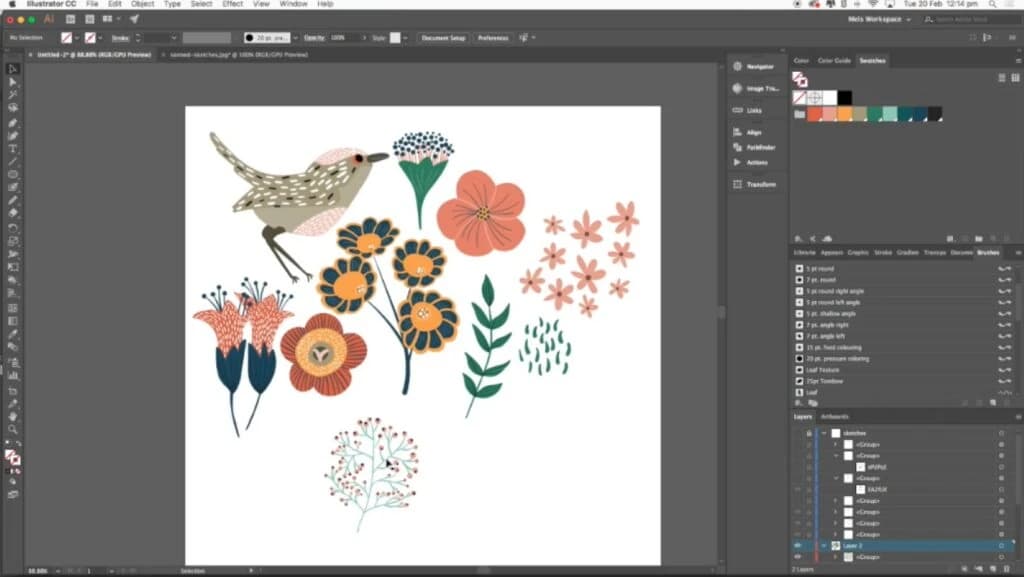
Surface Pattern Design for Beginners: 12 Classes to Start Your Journey
Have you ever admired the beautiful prints on your favorite notebook, the fun patterns on a piece of fabric or the intricate designs on wallpaper? If so, you've already noticed the impact of surface pattern design. This inspiring and approachable field is all about creating the repetitive artwork that decorates the world around us. Whether you’re looking for a relaxing new hobby or considering a creative career, learning the art of pattern design is a rewarding journey that you can begin from your own home. If you’re curious about the world of surface pattern design but are unsure where to start, stick around. We're about to explore what surface pattern design is, explain why it's a field worth getting into and break down common challenges you might face along the way. Most importantly, we'll show you 12 of the best online classes you can take to steadily build your skills and transform your artistic ideas into beautiful, repeatable patterns.

How Top Teacher Ebuka Mordi Sparks a Creative Community in Nigeria
Like many successful photographers, Ebuka Mordi didn’t receive a formal degree from a prestigious art school. Instead, he taught himself to create evocative images that capture the beauty of a brief moment, and through many years of practice, has developed a distinct style. Today, Ebuka is an Adobe Rising Star, Ambassador, Partner and Creative Resident, as well as an Agora Awards finalist, to name a few of his many awards and recognitions. And as a Skillshare Top Teacher, he’s able to share his expertise with thousands of students around the world. As student Ella Onyeka put it, Ebuka is “able to teach the basics so clearly and in a captivating way.” Similarly, student Jeff E remarked that “Ebuka presents the material in an easy-to-understand format.” With such glowing reviews, it seemed only natural for Ebuka to take his knack for teaching from the internet to the classroom. And luckily for some of Nigeria’s burgeoning photographers, that’s precisely what he did. From watching Ebuka’s Skillshare classes, we can try to imagine what an in-person class of his would entail. But at the end of the day, only the workshop’s participants truly know what the experience of attending it was like. These are some of the things they had to say. “I have really enjoyed myself,” one participant said. “The entire workshop exceeded my expectations, to be honest.” Another said that they “learned to tell authentic stories as they are, and not to pretend or create a story that is not relatable.” For them, “that was something that really stood out.” Even for participants who were initially unsure about attending, the experience was a resounding success. “At first I was scared to come because I was meeting new people and I did not know how it was going to be,” one participant shared. “But then here I am, and it has been amazing, and I am so glad I came.” Ebuka himself had only good things to say about the workshop, too. “Being one of the facilitators of this amazing workshop, I’ve been able to experience learning at a different level,” he explained. “I’ve seen participants who are willing to learn and who are willing to put in the effort.”